
Air-to-Water Heat Pump Repair
Air-to-water heat pump repair in Latvia — diagnostics, error troubleshooting and parts replacement. Request a repair, and we will contact you to arrange the repair for your region and system type.
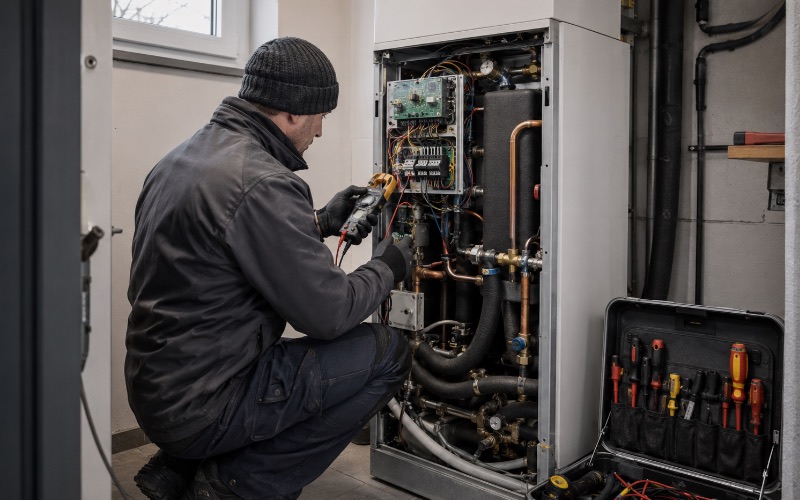
Air-to-water heat pump repair is most often needed when the unit loses efficiency, stops heating the heating water, or shows an error code. This system is more complex than the air-to-air variant — it includes a hydraulic circuit with a buffer tank, circulation pumps, three-way valves and a hot water boiler. Each of these components can develop problems that require professional diagnosis.
Air-to-water heat pump problems
One of the most common complaints is low supply temperature — radiators or underfloor heating don't reach the desired level, even though the unit runs continuously. The cause can be a refrigerant leak, compressor malfunction, or a control board fault. Hot water preparation problems — water doesn't heat up, or heating is unusually slow — often indicate a three-way valve failure, heat exchanger deposits, or a boiler heating problem.
Circulation pump failure shows up as a complete loss of heating, even though the heat pump is running and heating the internal water. Pressure loss in the system — through a leak or an expansion tank defect — causes repeated shutdowns and alarms. Sensor errors (flow, temperature or pressure) cause the unit to display an error code and stop working for safety reasons.
Unlike air-to-air systems, an air-to-water heat pump must also account for hydraulic circuit faults in addition to refrigerant circuit problems — these make up a significant share of all repair cases.
Diagnostic process
Air-to-water heat pump diagnostics starts with reading the error code from the unit's control panel. Modern heat pumps store recent errors in memory, which helps the specialist quickly identify the source of the problem. If no error code is available or it doesn't show a clear cause, an in-depth mechanical and electrical inspection is carried out.
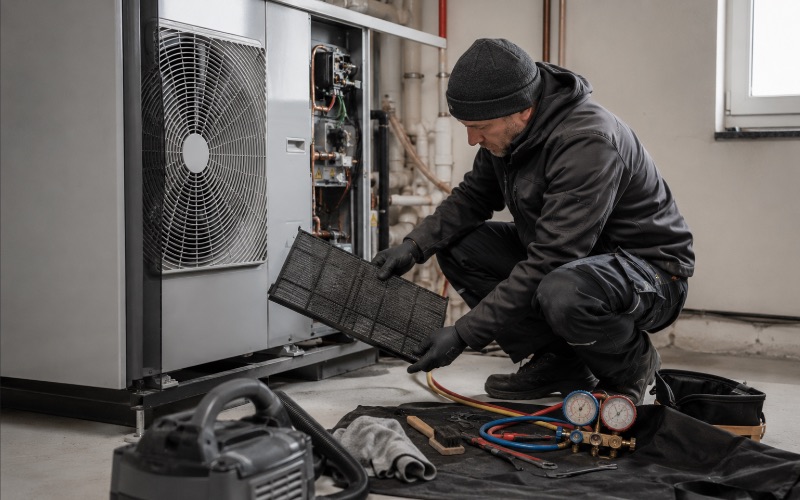
Refrigerant pressure is measured on the high and low pressure sides using gauge connections. Low pressure indicates a leak, while high pressure indicates a blocked expansion valve or a dirty filter. Checking the supply and return pipe temperatures lets the specialist determine whether the heat exchanger is working efficiently — a large temperature difference indicates poor heat transfer or deposits.
Electrical testing includes measuring compressor current draw, checking contactor condition and control board signals. Without professional equipment — gauges, multimeters, infrared thermometers and error code readers — quality air-to-water heat pump repair isn't possible.
Most commonly replaced parts
After diagnostics, the specialist determines which parts need replacing. Some wear out faster than others depending on operating conditions and heating load. Circulation pumps — in both the primary and secondary circuits — typically last 5–10 years, after which they need replacing. Expansion tanks lose pressure or their membrane splits, causing pressure fluctuations and repeated shutdowns.
Three-way valves, which switch between heating and hot water preparation, often get stuck or switch position incorrectly. Sensors — temperature, flow, pressure — are relatively cheap components, but their failure can completely stop the unit's operation. Filters (magnetic and sludge) need regular cleaning or replacement to maintain flow and protect the pumps.
Contactors and relays in the electronics unit fail from voltage fluctuations and mechanical wear. The compressor is the most expensive component — replacing it in an older unit can cost several thousand euros and requires careful evaluation before a decision is made.
When repair is needed
Several signs indicate that air-to-water heat pump repair is needed. Reduced heating capacity — the home doesn't warm up, even though the unit runs continuously and consumption is higher than usual. Unusual noises from the compressor, fan or circulation pump indicate a mechanical fault that will only get worse over time.
Error codes on the panel are a clear signal that something is wrong — even if the unit appears to be working. Increased electricity consumption without a change in usage habits often indicates a loss of efficiency: lack of refrigerant, dirty filters or compressor wear. Hot water problems — low temperature, slow heating, alternating warm and cold water — require prompt inspection.
Don't wait for the unit to stop completely. Small problems become expensive repairs over time — for example, a small refrigerant leak can lead to compressor failure, which costs many times more than timely leak repair.
Repair or replacement
An important question is whether the unit is repairable or needs full replacement. If the fault affects a small component — a sensor, valve, pump — repair is cost-effective and usually completed in one visit. If the compressor is damaged in an older unit (older than 10–12 years), replacement is often the wiser choice, since new units offer higher seasonal efficiency, better control functionality and a full new warranty.
When weighing repair against replacement, consider the unit's age, overall technical condition, spare part availability and comparative costs. General rule of thumb: if the anticipated repair costs more than 50% of a new unit's price, it's worth considering a full replacement. After diagnostics, the specialist provides a clear quote and recommendation, and the decision always remains yours.
How does the service work?
- ✓Free request
- ✓A suitable repair specialist
- ✓Diagnostics and a quote
- ✓Your data is safe with us
Heat pump not working?
Fill in the repair request — we'll be in touch within 5 minutes.
Request a Repair →Request a repair
Fill in the form — we'll be in touch within 5 minutes!
Frequently asked questions
Air-to-water heat pump not working?
Request a repair — we'll be in touch within 5 minutes!