
Heat Pump Maintenance
Heat pump maintenance and preventive upkeep across Latvia. Filter cleaning, refrigerant and pressure checks, electrical connection inspection — request maintenance before the heating season.
Heat pump maintenance is preventive upkeep that ensures the unit's longevity, high efficiency and reliable operation throughout the year. Unlike repair, which you request when something is broken, maintenance is carried out regularly to prevent problems before they occur. This page covers why maintenance matters, what it includes and how often it's needed.
Why maintenance matters
A heat pump is an investment of tens of thousands of euros, and its service life can exceed 15–20 years — but only with regular, quality maintenance. Without maintenance, the unit's efficiency declines over time, electricity consumption increases, and the risk of unexpected breakdowns rises. Most manufacturers also make the warranty conditional on proof of regular maintenance.
Heat pump upkeep is similar to car maintenance — a small regular investment saves large expenses down the road. Skipping one maintenance visit may not show an immediate effect, but over several years the consequences add up: lower efficiency, higher consumption, and sooner or later — a more expensive repair.
What maintenance includes
Professional heat pump maintenance includes several checks and actions that ensure all key components function correctly. Here's a typical list of maintenance tasks:
- Filter cleaning and replacement. Cleaning or replacing air filters to ensure free airflow through the heat exchangers.
- Refrigerant pressure check. Measurements that confirm the system has the correct refrigerant amount and no leaks.
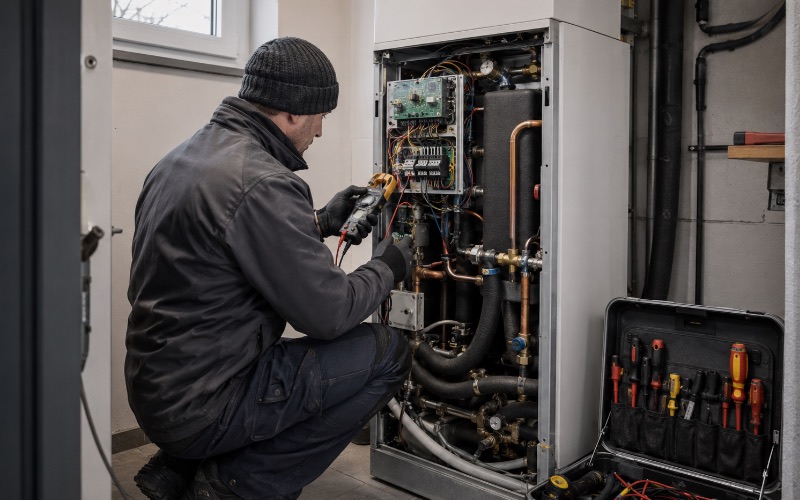
- Electrical connection check. Inspecting contactors, terminals and wiring condition to prevent electrical faults.
- Sensor calibration. Checking and recalibrating temperature, pressure and flow sensors so the control system receives accurate readings.
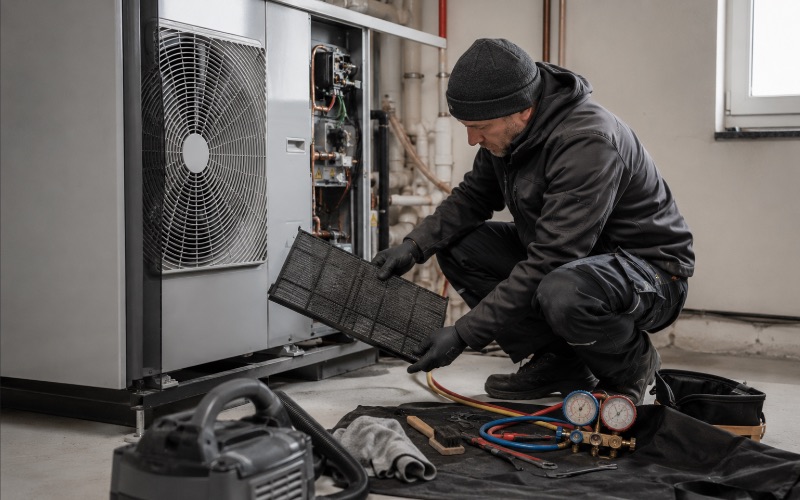
- Outdoor unit cleaning. Clearing the outdoor heat exchanger of leaves, dust and debris that hinder airflow.
- System performance test. Measurements comparing actual efficiency and heat output against the design values.
- Hydraulic system check. Checking water pressure, the expansion tank and circulation pump operation (for air-to-water and ground-source heat pumps).
- Condensate drainage check. Confirming that condensate flows away freely and there are no blockages.
How often to service
Most manufacturers and service specialists recommend maintaining a heat pump once a year. The best time is before the heating season — in August or September. This ensures the unit is ready for winter and runs optimally exactly when the load is highest.
Even if the unit runs without problems, regular maintenance matters — it reveals small deviations before they become serious breakdowns. For example, a small refrigerant leak may go unnoticed for months, but over time it can damage the compressor — a far more expensive repair than regular maintenance.
Filters and airflow
Filters and airflow are one of the simplest, yet most important, aspects of maintenance. Dirty filters and blockages in the air path reduce the unit's efficiency and increase electricity consumption.
Indoor air filters should be cleaned or replaced according to manufacturer instructions — usually every 1–3 months depending on how dusty the room is. Some filters can simply be washed, others must be replaced with new ones. The outdoor unit's heat exchanger should be checked at least once a year — cleared of leaves, branches and other debris that can interfere with airflow. In winter, it's important to make sure the outdoor unit isn't covered in snow or ice — a little frost is normal, but a large ice layer indicates a defrost system problem.
Refrigerant and pressure
Refrigerant is the substance that circulates in the heat pump and transfers heat between outdoors and indoors. Its amount and pressure must stay within limits set by the manufacturer. A low refrigerant level means there's a leak in the system, which needs to be found and fixed.
Low refrigerant amount reduces the unit's efficiency and, if not addressed, can damage the compressor — since the compressor is cooled by the refrigerant itself. Without enough refrigerant it overheats and can burn out. This is one of the most expensive repairs that could have been avoided with a simple maintenance check.
Pressure measurement requires professional equipment — gauges connected to the system's upper and lower pressure points. This measurement is one of the tasks you cannot do yourself, and it's an essential part of professional maintenance.
Electrical connections
Electrical faults are one of the most common causes of heat pump problems, especially in older units. Regular maintenance includes checking all key electrical components to catch wear before it causes a breakdown.
- Terminal tightness. Threads and connections can loosen over time from vibration and temperature fluctuations. They need to be tightened to prevent contact loss and short circuits.
- Contactor wear. Contactors are switches that turn on the compressor and fans. Their contacts wear over time and can cause malfunctions or unit shutdown.
- Capacitor health. Start and run capacitors can lose capacity, causing compressor or fan start-up problems.
- Control board condition. Electronic control boards are sensitive to moisture and temperature fluctuations. Maintenance includes their visual inspection and, if needed, cleaning.
Request maintenance to prevent these problems before they occur — we will contact you for your region and system type.
Maintenance benefits
- ✓Maintains high efficiency
- ✓Extends the unit's service life
- ✓Reduces breakdown risk
- ✓Keeps the manufacturer's warranty
- ✓Lower heating costs
Frequently asked questions
See also
Heat pump repair
Diagnostics and repair when the unit isn't working, shows an error code, or isn't heating.
Heat pump service
Technical support, settings and consultations, as well as problem diagnostics.
Heat pump error codes
The most common error codes and their meaning — what to do if your unit shows an error.
Time for pre-season maintenance?
Request maintenance — we'll be in touch within 5 minutes!