
Air-to-Air Heat Pump Repair
Air-to-air heat pump repair in Latvia — indoor and outdoor unit diagnostics, error troubleshooting and parts replacement. Request a repair, and we will contact you to arrange the repair for your region and system type.
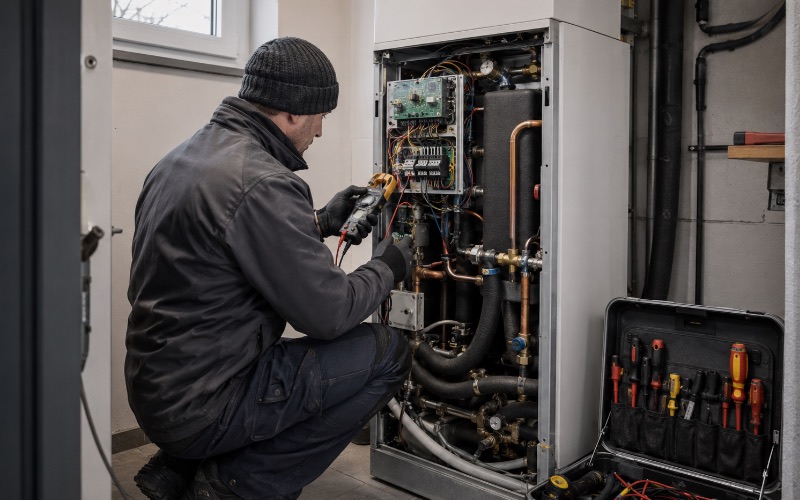
Air-to-air heat pump repair is most often needed when the indoor unit stops heating or cooling, the outdoor unit ices up, or water drips from the indoor unit. This system heats and cools air directly in the rooms, and its problems differ from the air-to-water variant — they're more related to airflow, condensate drainage and the defrost cycle rather than a hydraulic circuit.
Air-to-air heat pump problems
One of the most common complaints is reduced heating capacity — the room doesn't warm up, even though the unit runs continuously. The cause can be dirty filters, a low refrigerant level or a fan fault. Outdoor unit icing in winter — ice forms on the heat exchanger, reducing efficiency and, in severe cases, stopping the unit.
A fan motor fault shows up as unusual noises, vibration or reduced airflow from the indoor unit. Remote control problems — the unit doesn't respond to commands or shows incorrect temperature readings — are often linked to a faulty sensor or control board. A blocked condensate drain pipe leads to water dripping from the indoor unit, which can damage flooring, wallpaper or walls.
Unlike air-to-water systems, most air-to-air heat pump problems are concentrated around airflow and condensate management, though refrigerant circuit faults remain a possible and more expensive scenario.
Indoor and outdoor unit repair
An air-to-air heat pump consists of two units — indoor and outdoor — and each requires a different repair approach. Indoor unit repair is usually simpler and cheaper. It includes cleaning or replacing filters, cleaning the fan and balancing the blades, cleaning the condensate pan, and checking — and if necessary replacing — the control board.
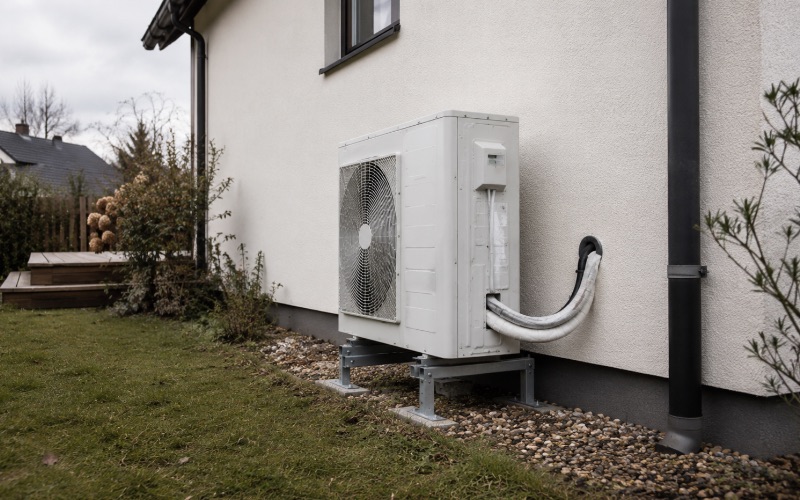
The outdoor unit contains the compressor, fan, refrigerant circuit and defrost system. Its repair is more complex and usually more expensive. Common jobs include checking compressor current draw and vibration, replacing the fan motor, topping up refrigerant after finding a leak, and checking the defrost system sensor and valve.
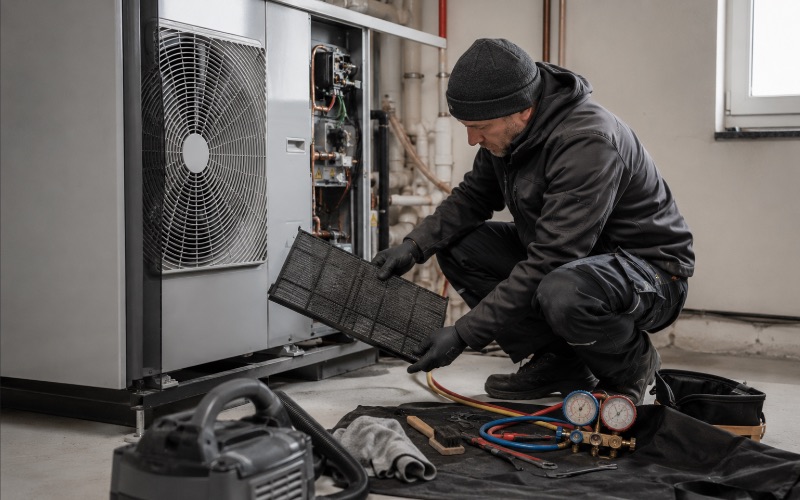
Air-to-air heat pump diagnostics starts with reading the error code from the indoor unit or remote control. Some jobs — such as refrigerant top-up — require a certified F-gas specialist and specialized equipment. Without a correct diagnosis, the repair may be ineffective and the problem will return shortly after.
Condensate drainage problems
A blocked condensate drain pipe is one of the most common air-to-air heat pump problems, especially in cooling mode or during the defrost cycle. Condensate forms when moist room air contacts the cold heat exchanger — water drips from the indoor unit onto the floor or down the wall, leaving moisture marks and potentially damaging the wall finish.
The cause is most often a blockage — dust, mold, or plant roots at the outdoor end of the pipe. Sometimes the problem is a damaged drain pan or drainage pump. Clearing the pipe is partly possible yourself, using suction or special tablets, but if that doesn't help, a specialist's help is needed. As a preventive measure, it's advisable to check the condensate drainage before each heating or cooling season to avoid unexpected water damage in the room.
Cold-weather mode problems
In a Latvian winter, an air-to-air heat pump's outdoor unit naturally builds up ice, as water vapor from the air condenses and freezes on the heat exchanger surface. Normally the unit automatically activates a defrost cycle, which briefly reverses the cooling direction and melts the ice. If this system doesn't work correctly, ice accumulates, blocks airflow and the unit loses efficiency or stops completely.
Defrost system problems have various causes: a faulty sensor that doesn't register the freezing level, a control board error, or a reversing valve that doesn't switch to defrost mode. The specialist checks sensor readings, valve operation and control logic. Sometimes the problem isn't in the unit but in a poor outdoor unit location — if the unit is in a spot with high humidity or poor air circulation, icing is more intense. Proper repair may also include relocating the unit or adding protective covering to improve airflow around the unit.
When repair is needed
Several signs indicate that air-to-air heat pump repair is needed. Reduced heating or cooling capacity — the room doesn't warm up or cool down, even though the unit runs continuously and consumption is higher than usual. Unusual noises from the indoor or outdoor unit indicate a fan, refrigerant pressure or compressor problem.
Water dripping from the indoor unit is a clear signal of a condensate drainage problem. Error codes on the indoor unit or remote control are a direct indication for diagnosis and should be checked, even if the unit appears to keep working. Ice buildup on the outdoor unit that doesn't clear after a defrost cycle indicates a defrost system fault.
Don't ignore these signs — timely repair is considerably cheaper than a completely broken unit or moisture damage in the room. Request a repair through our form, and we will contact you to arrange the repair for your region and system type.
How does the service work?
- ✓Free request
- ✓A suitable repair specialist
- ✓Diagnostics and a quote
- ✓Your data is safe with us
Heat pump not working?
Fill in the repair request — we'll be in touch within 5 minutes.
Request a Repair →Request a repair
Fill in the form — we'll be in touch within 5 minutes!
Frequently asked questions
See also
Air-to-air heat pump not working?
Request a repair — we'll be in touch within 5 minutes!